


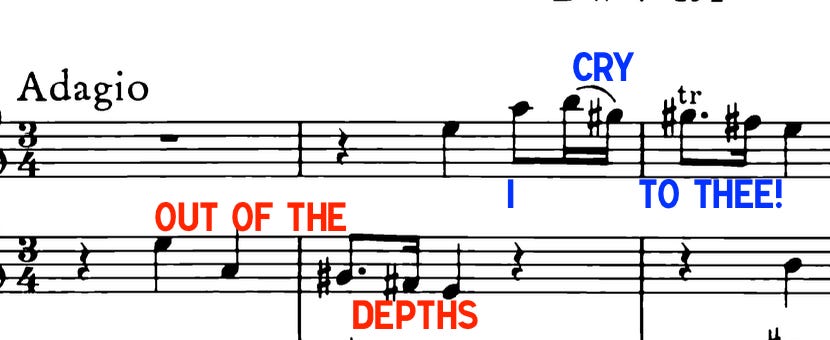
At just 22 years old, Bach set the immortal words of David, ‘Out of the depths I cry to thee, O Lord.’ From the opening bars, we see depths, cries:
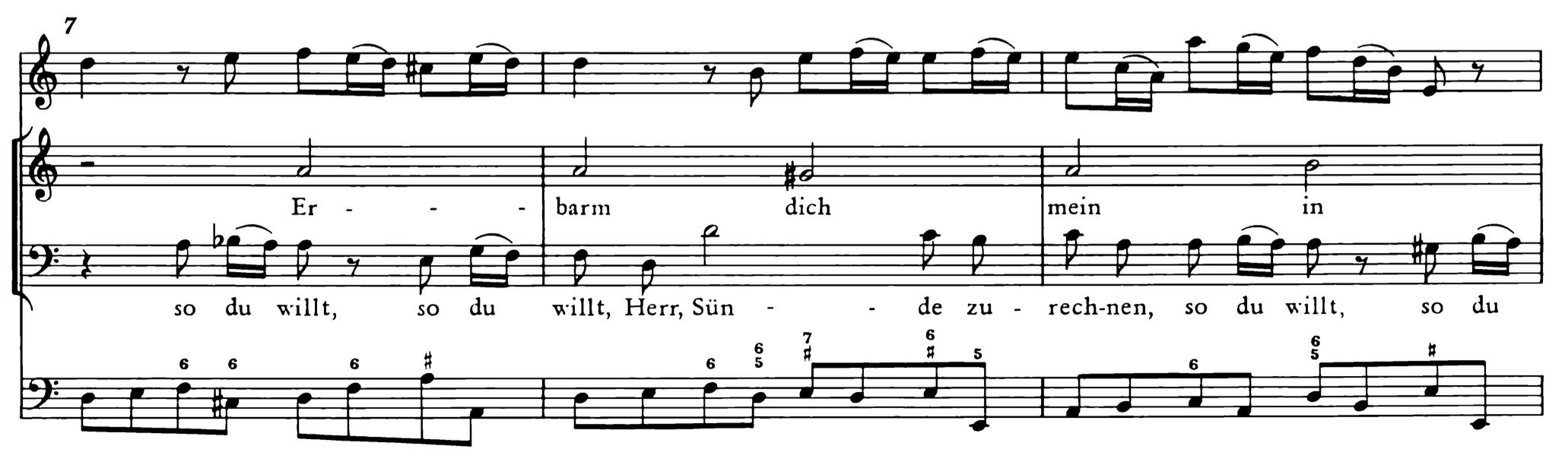
The second and fourth movements already show Bach’s interest in using chorale melodies in his cantatas. To the Psalm text, Bach adds a 1588 Hymn by Bartholomäus Ringwaldt, asking for mercy, Erbarm dich mein. How lucky we are to see seeds of the Matthew Passion planted as early as 1707!
The finale uses a fugue with a countersubject to paint one single line of text: And he will redeem Israel is painted with lively 16th notes, joyful even, while, from all his sins appears as a rising chromatic line. Bach, with a fugue, realizes theology:

I forgot to mention in the episode: The fugue in the last movement was arranged as a fugue for organ in g minor, BWV 131a. The attribution to Bach has been contested, but it nevertheless makes for a wonderful fugue playable by one person. When I was making my own electric rendition of the fugue, I was struck by how similar parts are to the organ fugues in c minor, BWV 537, a very late work, but also the youthful BWV 551, both of which were covered on this show. I like this recording a lot, have a listen!
Rudolph Lutz’ performance
Masaaki Suzuki’s recording
We Rely Exclusively on Paid Subscriptions! Help WTF Bach endure:
Join at
WTFBach.com
This is the only place Evan checks comments regularly.
You can also make a one-time donation here:
https://www.paypal.me/wtfbach
https://venmo.com/wtfbach
Thank you for your help!
Concepts Covered:
Bach's Cantata BWV 131, "Aus der Tiefen rufe ich, Herr, zu dir," composed in 1707 when the composer was just 22 years old in Mülhausen, organist at St. Blasius Church, stands as a remarkable setting of Psalm 130 for bassoon, oboe, strings, and continuo. This sacred cantata integrates the 1588 Lutheran hymn text by Bartholomäus Ringwaldt, "Herr Jesu Christ, du höchstes Gut," demonstrating Bach's early mastery of chorale melody integration in cantata structure. The fugal finale translates theological meaning through musical architecture. The cantata's closing movement exists in an organ arrangement (BWV 131a.) N.B. the dedication to Dr. Georg Christian Eilmar, clergyman at St. Mary's Church.


